2021년 7월 1일 - 오늘의 영문 필사
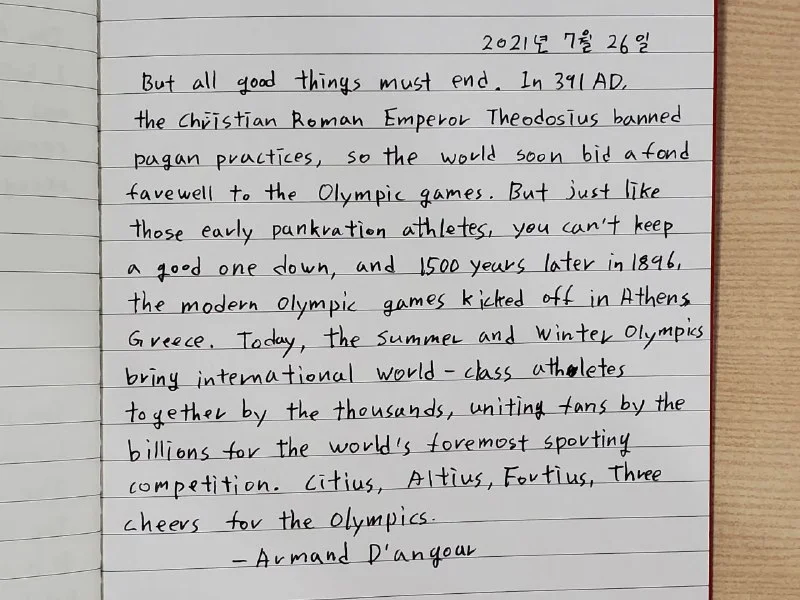
But all good things must end.
In 391 AD, the christian Roman Emperor Theodosius banned pagan practices, so the world soon bid a fond farewell to the Olympic games.
But just like those early pankration athletes, you can't keep a good one down, and 1500 years late in 1896, the modern Olympic games kicked off in Athens, Greece.
Today, the Summer and Winter Olympics bring international world-class athletes together by the thousands, uniting fans by the billions for the world's foremost sporting competition.
Citius, Altius, Fortius.
Three cheers for the Olympics.
— Armand D'angour
📑단어노트
pagan : 이교도
foremost : 으뜸가는, 선두의
pankration : 고대 그리스 격투기
foremost : 으뜸가는, 맨앞의, 선두의
✔해석
모든 좋은 일에는 끝이 있기 마련이다.
서기 391년 그리스도교 로마 황제 시어도시우스는 이교도 관습을 금지했고, 전세계의 올림픽 경기는 막을 내렸다.
하지만 전직 판크라티온 선수들처럼 좋은 것은 그냥 보고 있지 않았다.
1500년이지난 1895년 그리스 아테네에서 현대 올림픽이 열렸다.
오늘날의 하계, 동계 올림픽은 전세계 최고의 운동선수 수천명과 팬들을 한 곳에 모으는 세계 최고의 스포츠 경기다.
보다 빠르게, 보다 높게, 보다 힘차게 가 올림픽의 세가지 표어입니다.
🧾나의 한 마디
지금의 올림픽은 그 정신을 잃은게 아닐까?
올림픽 뿐만 아니라 스포츠 전반이 돈의 논리로 시작과 끝을 맺는다.
그만큼 많은 사람의 관심이 있다는 반증이겠지.
🎈부가 컨텐츠
 The ancient origins of the OlympicsThousands of years in the making, the Olympics began as part of a religious festival honoring the Greek god Zeus in the rural Greek town of Olympia. But how did it become the greatest show of sporting excellence on earth? Educator Armand D'Angour explains the evolution of the Olympics. (Directed by ...www.ted.com
#하루15분영문필사모임 #영문필사 #LlifelogBlog #라이프로그블로그 #필사 #올림픽
공유
댓글
아직 댓글이 없습니다. 첫 번째 댓글을 남겨보세요.